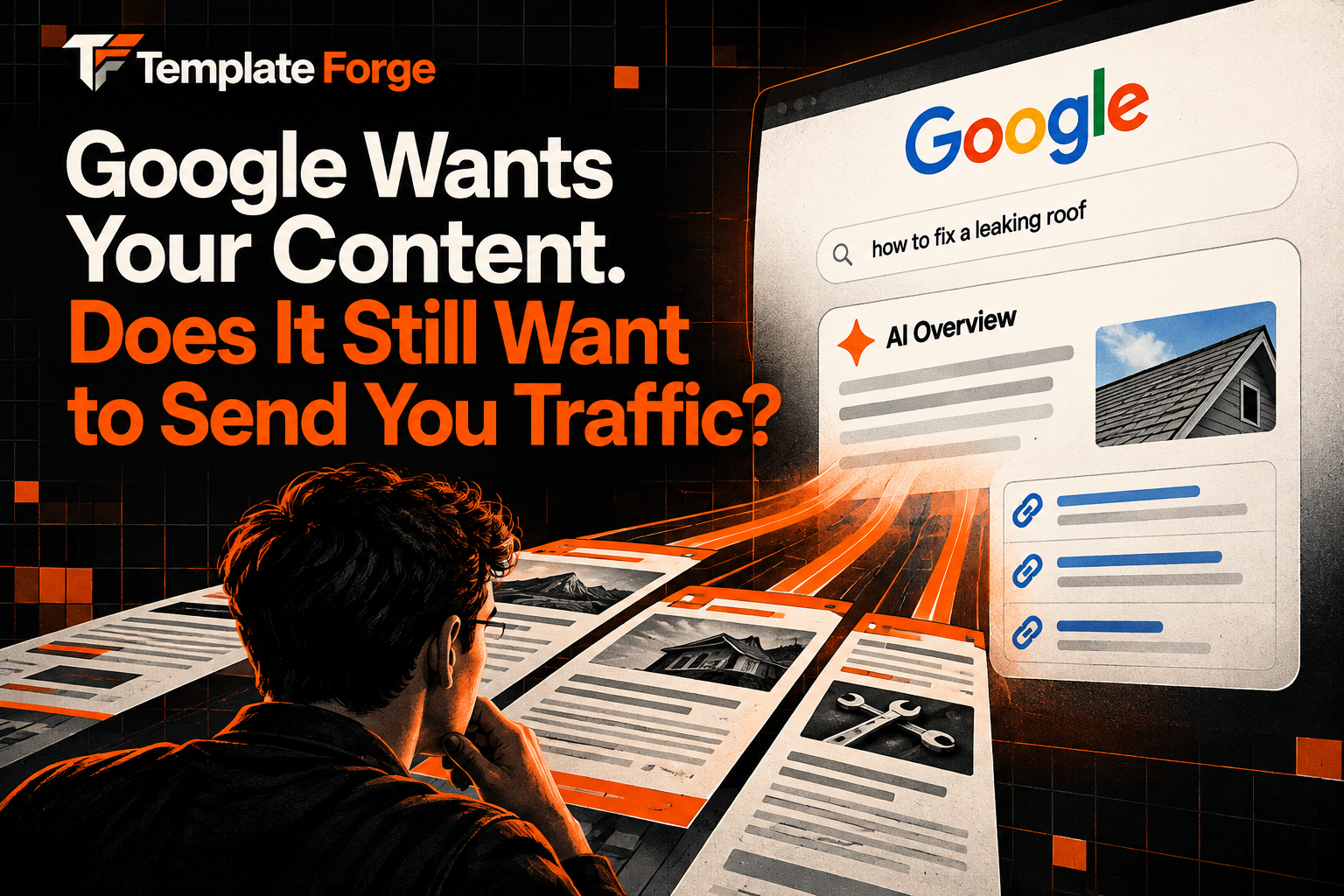
For a long time, the relationship between websites and Google was easy enough to understand. You published something useful. Google indexed it. Somebody searched for it. Google showed the result, and some of those people visited your website.
Google got a search engine full of useful information. Website owners got discovery and traffic. Nobody needed to write vows, but everybody understood the arrangement.
Generative AI makes that relationship less tidy. Google can now read information from websites, combine it, summarize it, cite sources, and answer increasingly complicated questions directly inside Search.
That may be convenient for the person searching. It also raises a reasonable question for the people making the information: If Google can answer the question before the searcher visits the source, what exactly is the source getting out of the deal?
The old deal was not charity.
It is tempting to tell this story as if websites donated information to Google and Google kindly returned visitors. That was never really the relationship. Google needed useful destinations. Websites needed discovery at the exact moment somebody had a question, problem, or buying intention.
Both sides benefited, and an entire SEO industry grew around improving the odds of that connection happening. We optimized titles, built internal links, improved performance, added structured data, submitted sitemaps, fixed crawl problems, wrote useful pages, and watched Search Console.
The measurement at the end was usually some version of the same thing: Did somebody come to the website?
Rankings mattered because rankings could produce impressions. Impressions mattered because they could produce clicks. Clicks mattered because a person had finally reached the place where the business, publisher, or creator could do something useful with the attention.
AI Search has not removed that path. It has inserted another destination in front of it.
The strange new question is whether your website can succeed in Search without the searcher ever reaching your website.
Google's version of the story is not "we do not need websites anymore."
Google says essentially the opposite. In its August 2026 update for website owners, Google said its generative AI features are designed to help people find and visit useful websites. It says AI Overviews now reach more than 2.5 billion monthly active users and AI Mode has passed one billion monthly users.
Google also says people using these features search more often, ask new kinds of questions, and have new opportunities to discover brands, publishers, and creators. Search is not becoming some tiny abandoned corner of the internet while we all argue about it.
Google has also been adding more links and website previews inside AI experiences, apparently because it understands the obvious concern: if AI answers become the destination, publishers and businesses have less reason to keep supplying the road.
Google is describing what it sees across a gigantic search ecosystem. That does not automatically tell us what happens to one publisher, one small business, or one type of query.
The independent click data is considerably less cheerful.
In 2025, Pew Research Center analyzed browsing behavior from 900 U.S. adults. When a Google search page contained an AI summary, users clicked a traditional search result in 8 percent of visits. When an AI summary was not present, they clicked a traditional result in 15 percent of visits.
Links cited inside the AI summaries did not exactly save the afternoon. Pew found those links were clicked in only about 1 percent of visits to pages containing an AI summary. People were also more likely to stop browsing after seeing an AI summary, 26 percent compared with 16 percent without one.
Pew's study was observational, so it still left an obvious question: were AI summaries causing the behavior, or were the kinds of searches that triggered AI summaries simply different?
A 2026 preregistered field experiment tried to get closer to that answer. Researchers studied 1,100 Google users and experimentally changed their exposure to AI Overviews and AI Mode. They found that removing Google's AI features increased click-through to publishers, while an AI Mode-only experience reduced outside referrals.
Traditional-result clicks when an AI summary appeared compared with searches without one.
Visits where users clicked a source link directly inside the AI summary.
The preregistered experiment found higher publisher click-through when AI features were removed.
Year-over-year Google Search referrals across Chartbeat's publisher network from July 2025 to July 2026.
That last number needs a large warning label. Chartbeat's network skews toward news and media publishers. It is not evidence that every website on the internet lost 40.2 percent of its Google traffic, and it does not tell us that a plumber, dentist, photographer, or local store experienced the same decline.
It does tell us that publishers worried about declining search referrals are not discussing an imaginary problem.
A citation and a visitor are not the same thing.
This is where the language around AI visibility gets slippery. Being cited by an AI answer can absolutely have value. A business name can be exposed to somebody who had never heard of it. A publication can become associated with a subject. A brand can appear repeatedly in the research process before somebody eventually searches for it directly.
All of that is real. It is also not the same thing as a website visit.
A visitor reaches your environment. They can see your services, join your email list, read another article, request a quote, buy something, book an appointment, view an ad, or become a returning reader.
A citation inside somebody else's answer gives you considerably less control over what happens next. We should probably stop treating "visibility," "citation," "impression," and "traffic" as interchangeable just because all four can appear in a marketing report.
Being named in the answer can be valuable. It is still not the same transaction as receiving the person who asked the question.
Google now gives websites an opt-out. That creates another question.
As of August 31, 2026, Google says its Search Console control for generative AI Search features has rolled out worldwide. Website owners can choose not to let their site appear in and help ground responses in generative AI Search features such as AI Overviews and AI Mode.
Google says choosing that option will not be used as a ranking signal for traditional search results outside those AI experiences. That is meaningful control. It also comes with an obvious tradeoff: Google says sites that opt out will not receive traffic or impressions from those generative AI features.
So the choice is not exactly "let us use the content or keep everything else the same." The choice is closer to "participate in the growing AI section of Search under these terms, or remove yourself from that section."
European regulators are already asking publishers what they think about that arrangement. Reuters reported in September 2026 that EU antitrust regulators were questioning publishers about whether Google's new opt-out meaningfully addresses their concerns.
Publishers and small businesses do not have the same problem.
This distinction is important enough to ruin several dramatic headlines, which is probably why it gets skipped. A news publisher may monetize the pageview itself. The visit can produce advertising revenue, subscriptions, additional article views, and returning readers.
A local plumber does not normally care whether somebody reads six plumbing articles and admires the site's session duration. The plumber needs the person with water coming through the ceiling to call.
A photographer may care about portfolio views and inquiries. A restaurant may care about reservations. A lawyer may care about qualified consultations. A template store may care about product discovery and sales.
Fewer visits can immediately affect advertising, subscriptions, and reader growth.
Calls, bookings, inquiries, directions, and purchases matter more than raw pageviews.
AI visibility may help awareness, but the website still matters when somebody needs to compare, trust, or buy.
Losing informational clicks can still matter to small businesses, especially when articles introduce people to the brand. But the economic effect is not automatically identical to what happens at a publication funded by audience volume.
Measure your own search traffic. Measure your own calls, inquiries, sales, and branded searches. The industry trend matters, but your business still has to pay its own bills.
So what exactly is SEO for now?
The easy answer would be to declare SEO dead for approximately the 900th time, collect a few shares, and come back next year when it dies again. That would also be lazy.
Search is still one of the largest discovery systems on the planet. Google is still showing conventional results. AI responses still cite and link to websites. People still search for products, services, businesses, comparisons, prices, locations, reviews, and things they eventually need to do outside Google.
What may be changing is the assumption that every successful search appearance should end in an immediate click.
Modern SEO may increasingly have several jobs at once:
- Earn traditional search visibility where clicks still happen.
- Make the business understandable enough to be cited accurately in AI answers.
- Build enough authority that people recognize or later search for the brand directly.
- Protect high-intent commercial pages where the visitor still needs details Google cannot complete for them.
- Create useful content that introduces the business without assuming every article visit becomes a sale.
- Build direct channels so the entire audience does not depend on a search platform continuing to send the same kind of traffic forever.
That is a broader job description than "rank number one and watch the clicks arrive." It is also harder to measure, which is convenient for anybody selling mysterious AI visibility dashboards and considerably less convenient for the business owner trying to decide whether any of this made money.
Do not let a new metric convince you that the old business outcome stopped mattering. If you need calls, sales, readers, or inquiries, measure those too.
The uncomfortable question is still the useful one.
Google needs useful information for AI Search to be useful. Publishers, creators, businesses, forums, documentation sites, researchers, and ordinary people produce an enormous amount of that information. Google now has more ways to transform it into an answer before the searcher reaches the original page.
Maybe the new exchange still works. A citation may create brand awareness. AI visibility may influence later searches. The fewer visitors who do click may arrive with stronger intent. Some businesses may ultimately care more about being selected than being read.
But website owners are allowed to ask for evidence before deciding that this is automatically equivalent to the traffic they used to receive. That is not resistance to technology. It is measurement.
And if the answer eventually becomes "you still need to create the content, but the search engine no longer needs to send many people to it," then SEO has not disappeared. The transaction underneath it has changed.
Sources behind the argument
- Google: New opportunities, control and insights for website owners
- Pew Research Center: Google users are less likely to click when an AI summary appears
- Wang, Gleason, Bart, Wilson, and Metaxa: AI in Search Reduces Publisher Referrals Without Improving User Experience
- Search Engine Journal: Chartbeat publisher referral data
- Reuters: EU regulators question publishers about Google's AI Search opt-out
So did SEO still do its job?
If Google uses your content to answer the searcher's question, cites your website, and the searcher never visits it, maybe the answer depends on what you expected SEO to accomplish in the first place.
Search is not disappearing. Google is not disappearing. SEO probably is not disappearing either. But website owners should notice when a visit becomes an impression, an impression becomes a citation, and somebody quietly starts calling the two equal.
The comment section has entered the chat
Join the discussion
0 approved commentsIf Google uses your content to answer the searcher's question but the searcher never visits your website, did SEO still do its job?
No approved comments yet. You could be first, which is either exciting or suspiciously responsible.
Add your two cents
Keep it useful, keep it human, and disagree without flipping the table. Comments are reviewed before they appear.