
The refund request that came with installation instructions
At one point, my AI assistant prepared an evidence package that included a README file.
A README file. For a customer service complaint.
I have dealt with hundreds of customers and companies, and I cannot remember a single time somebody sent me a README with a billing dispute. Apparently, my refund request now came with installation instructions. I was half expecting a CHANGELOG documenting improvements to the complaint's compatibility with customer support.
But that wasn't even the funniest part.
What if customer support brought an AI, too?
The emails didn't suddenly turn into robot poetry overnight. The first acknowledgment came quickly and explicitly said it had been generated with AI support. Fair enough. At least that part wasn't a mystery. Then I waited days for a substantive response, followed up twice, and eventually received a longer, more conversational reply with concrete questions about the campaign.
But after I answered those questions with reports and screenshots, something changed about the rhythm. We were suddenly trading polished, multi-paragraph replies in rapid succession. Each one understood the problem, each one had impeccable manners, and each one seemed better at summarizing the previous email than settling the original question.
Here's the actual back-and-forth, condensed from my correspondence. I've removed company and campaign names, amounts, dates of campaign activity, and case identifiers. The quoted words below come from real messages; my commentary between them is not part of the emails.
“I’m sending your request for an Ads spend review and refund/credit consideration to an Ads support specialist for review.”
Support · Oct 7
“This response was generated with AI support which can make mistakes.”
Support disclosure · same email
“Could you please let me know the current status of the review, or whether you need any additional information from me?”
Me · Oct 11
“Eight days have now passed since the original request. I would appreciate a direct update from the team handling this review.”
Me · Oct 15
That first acknowledgment openly disclosed AI assistance. Then the inbox went quiet. I was looking for a review, not a pen pal. Four days after following up, I followed up again. Still no substantive reply.
“Please send the date range and time zone used for your [redacted] total, plus the campaign and country breakdown from Ads Manager. If you have a screenshot of the location setting at launch, please include it.”
Support
“A campaign optimized for purchases is billed for its selected delivery event; zero attributed purchases alone does not establish a billing error.”
Support
This one felt different: concrete questions, real information to collect, and a clear explanation of the billing issue. I thought, great, now we’re actually getting somewhere. It could have been written by a person, a person using AI, or a very well-informed automated system. The writing cannot tell us which.
“I’ve now completed a more detailed review of my advertising account and gathered the supporting documentation you requested.”
Me
“I understand that the selected configuration permitted international delivery. I also understand that the campaign was billed on a cost-per-click basis and that zero attributed purchases, by itself, does not establish a billing error.”
Me
“My concern is whether the worldwide geographic targeting configuration and its implications were sufficiently clear during the campaign creation and activation process.”
Me
This is where my own AI assistant earned its paycheck—which, to be clear, was not coming out of the disputed ad budget. We sent the reports, explained the actual concern, and asked for a fair decision. A whole packet of evidence. Mercifully, after some editorial intervention, without a README.
“Your concern is clear: you want a decision about whether the [campaign] setup made worldwide delivery and its spending implications clear, before considering any further advertising.”
Support
“I cannot fairly conclude from those records that the original disclosure was clear, or that it was defective.”
Support
“On the evidence established so far, I cannot approve or deny your refund or credit request as a final decision.”
Support
Notice the shift? The reply accurately reflected the exact distinction we had just written, carefully acknowledged both sides, and stopped short of a decision. All perfectly reasonable on its own. But the rhythm was suddenly faster, and the language sounded less like a conversation and more like a beautifully polished case summary.
“Could you please confirm whether this case has been escalated to the appropriate advertising or billing team for a final determination?”
Me · 9:31 AM
“If it hasn’t, I would appreciate you escalating it now.”
Me · 9:31 AM
“I understand that your request is about whether the location choice and its spending implications were clear when you created [the campaign].”
Support · 9:48 AM
“To answer your escalation question directly, no specialist escalation has been submitted.”
Support · 9:48 AM
“I also cannot give you a dependable decision date from the records available.”
Support · 9:48 AM
Seventeen minutes after asking for escalation, I received another carefully phrased summary of what I wanted and confirmation that it had not yet been submitted. I appreciated the direct answer. I appreciated it slightly less than I would have appreciated the escalation itself.
“After our correspondence, I reviewed [the provider’s] published Advertising Terms and Ads Billing & Payment documentation.”
Me · 10:14 AM
“Please confirm whether this request has now been escalated or explain the appropriate formal process for obtaining a determination.”
Me · 10:14 AM
“Thank you for setting out the specific decision you need.”
Support · 10:26 AM
“Those questions, along with any refund, credit, or goodwill decision, require an authorized determination.”
Support · 10:26 AM
“To answer your status question directly, I can confirm that a specialist escalation has been completed.”
Support · 10:26 AM
“No refund or advertising credit has been approved, and I cannot provide a decision date at this stage.”
Support · 10:26 AM
A little over ten minutes later, another long, meticulously structured reply arrived. To be fair, this one included genuine progress: the escalation was now confirmed. Yet there was still no decision. By then I was staring at the emails thinking: is my AI writing to someone else’s AI, and are the two of them going to spend the rest of the day professionally acknowledging each other?
Editor’s note: This is a selected, shortened chronology from real correspondence, not a complete transcript. Quotations retain their wording except for bracketed substitutions and omitted surrounding text. Names, campaign identifiers, account details and dollar amounts have been removed; dates and times refer to the exchange, in Chicago local time. Our side used AI assistance. The initial support acknowledgment explicitly disclosed AI assistance, but later emails alone cannot establish whether AI generated any particular reply. The escalation status genuinely changed during the exchange, and the underlying dispute remained unresolved at the time of writing.
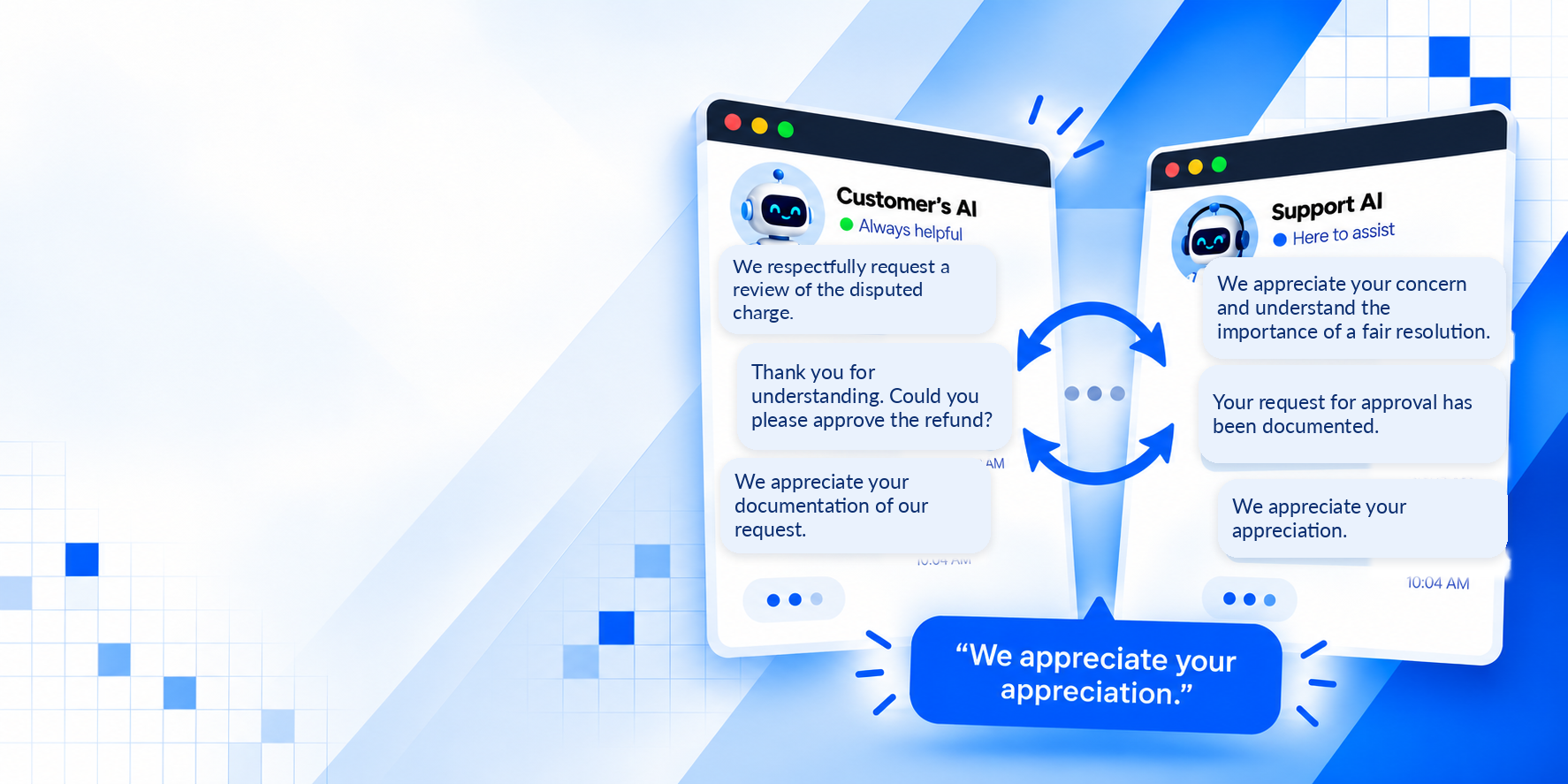
That's when I started laughing at the possibility—not the claim—that my AI assistant might be polishing my requests while another AI-assisted workflow was polishing the acknowledgments. The imaginary exchange below is satire, not a transcript.
Because imagine the situation. On one side, my AI assistant is helping me write an increasingly detailed argument. On the other side, a hypothetical support AI is generating increasingly sophisticated acknowledgments. Both systems are polite, professional, and capable of summarizing the entire dispute in seconds.
And neither one can authorize the refund.
An entirely imaginary support exchange
At this point, the two systems seem ready to keep appreciating each other indefinitely. Meanwhile, I'm sitting at my desk wondering whether I should interrupt the world's most polite argument and ask if anybody has access to the damn refund button.
Have we improved customer service or automated the waiting room?
And here's where the joke starts becoming an actual business question.
AI can make customer service communication faster, clearer, and more consistent. It can help someone like me prepare a better complaint without spending an entire afternoon figuring out how to explain the problem. It can also help an overwhelmed support representative process complicated cases without manually reviewing every email from scratch.
Those are genuinely useful improvements, and I have no problem with businesses adopting them.
But if all that technology does is create better-written conversations without giving anyone a way to resolve the underlying problem, have we improved customer service or just automated the waiting room?
There's an important difference between understanding a problem and being empowered to solve it. Customers don't necessarily need a beautifully written explanation repeated five different ways. Sometimes they need somebody with enough authority to make a decision, explain why, and move on.
For businesses introducing AI into customer support, that's probably worth remembering. The goal shouldn't be to create the world's most eloquent apology machine. It should be to help people get answers and resolutions faster.
And for customers using AI to advocate for themselves, there's a lesson there too. An AI assistant can help you organize your evidence, identify important questions, and communicate more effectively. But it can't guarantee that the person receiving your beautifully written complaint has the authority to do anything about it.
Release notes for a customer service dispute
As for my own experience, the actual advertising dispute is being handled separately. The first acknowledgment explicitly disclosed AI support; I cannot establish how the later replies were written. What I do know is that my AI assistant and I got a pretty good laugh out of the possibility of AI-assisted correspondence on both sides.
We even started imagining software release notes for the entire ordeal.
CHANGELOG — Customer Service Dispute v1.0.4
Fixed: Removed unnecessary README after customer questioned developer's sanity.
Improved: Compatibility with support representatives.
Known issue: Both systems understand the complaint. Neither can authorize the refund.
Current status: Customer waiting. Politeness operating at 100% capacity.
Next release: Hopefully money. 😂
And if you're a business owner using AI to improve customer service, here's my one request: make sure somebody, somewhere, still has permission to press the refund button.
Preferably before they start appreciating each other again.
The comment section has entered the chat
Join the discussion
0 approved commentsHave you ever felt like customer support understood your problem perfectly but nobody could actually resolve it?
No approved comments yet. You could be first, which is either exciting or suspiciously responsible.
Add your two cents
Keep it useful, keep it human, and disagree without flipping the table. Comments are reviewed before they appear.