
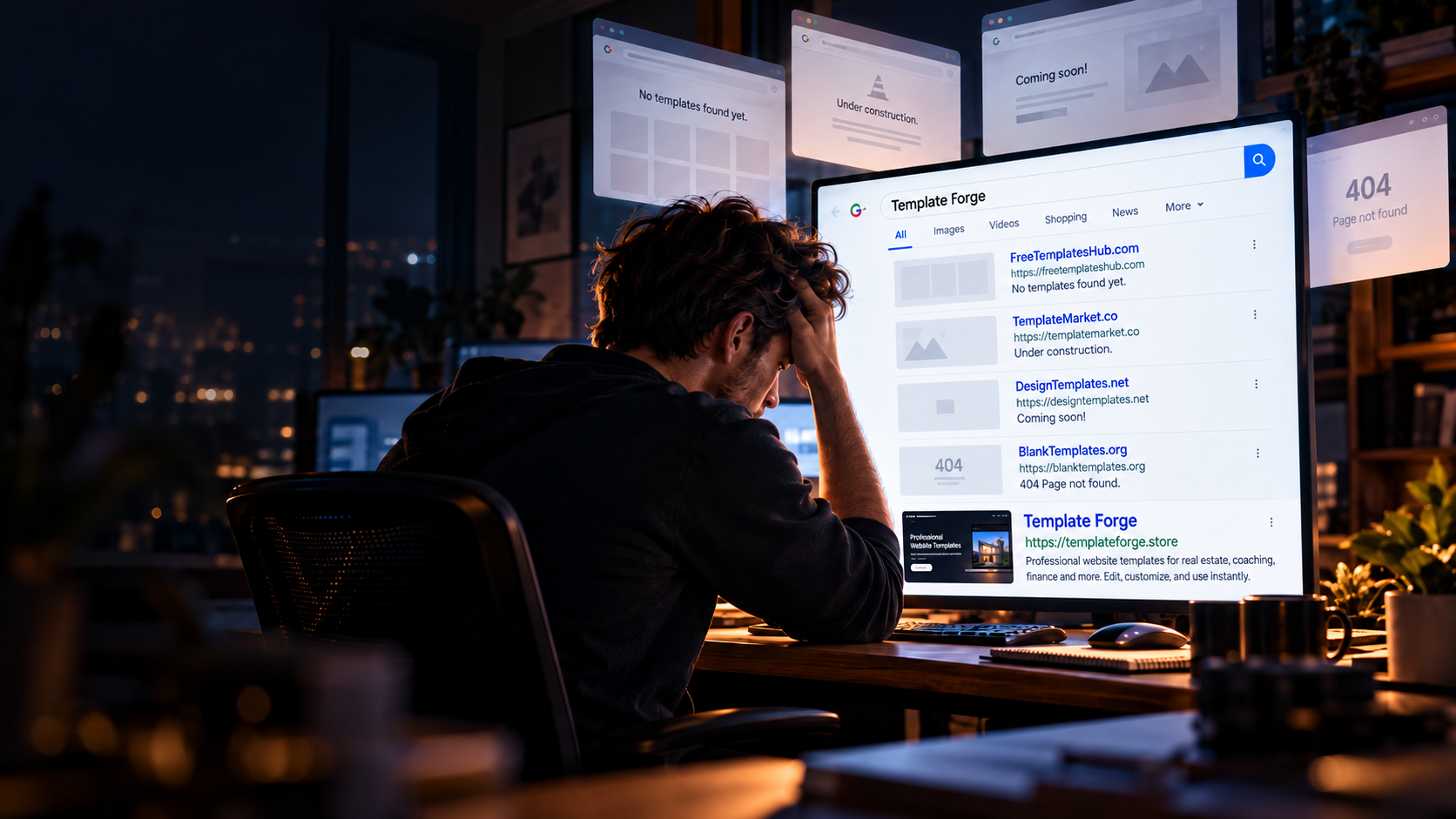
The first result had a template shop. The shop had no templates.
In the Google search I later recorded for Template Forge, the first visible organic result was a similarly named website, Templates Forge, at templatesforge.com. I clicked through to its shop and found category links, a decent-looking page structure, and a message sitting in the middle of the catalog: “No templates found yet. Check back soon for new templates!”
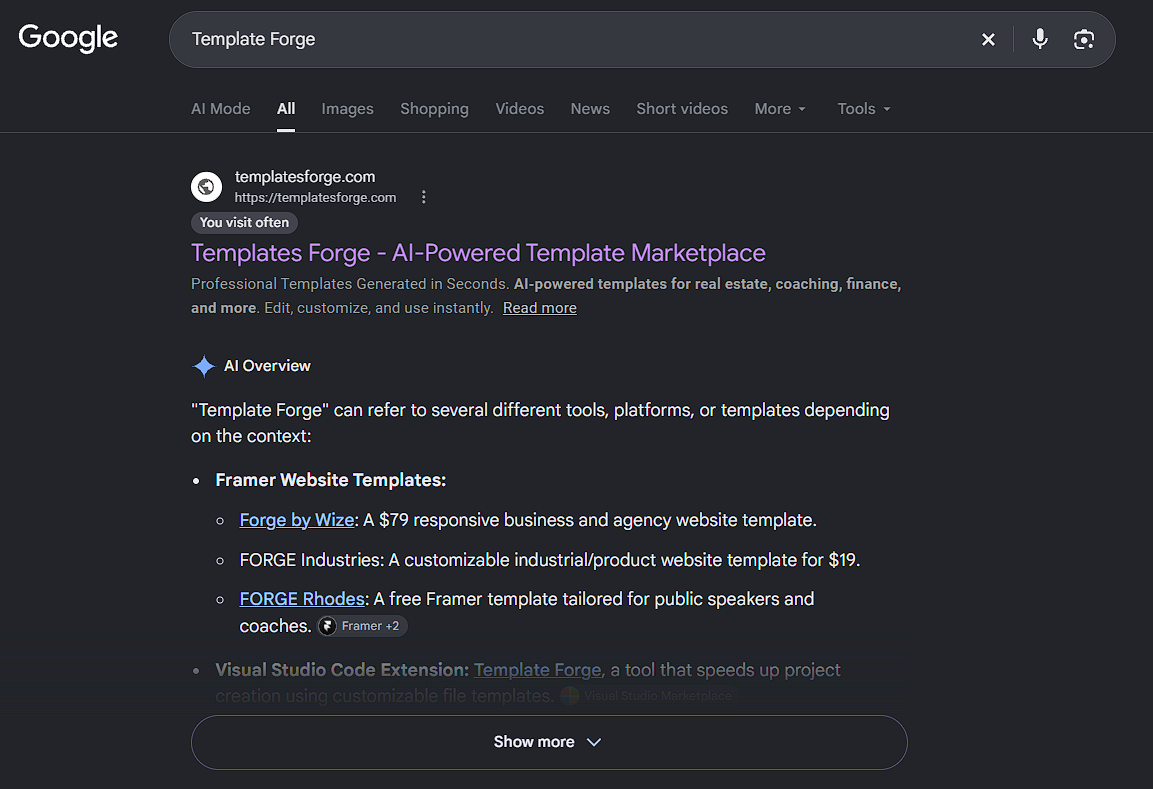
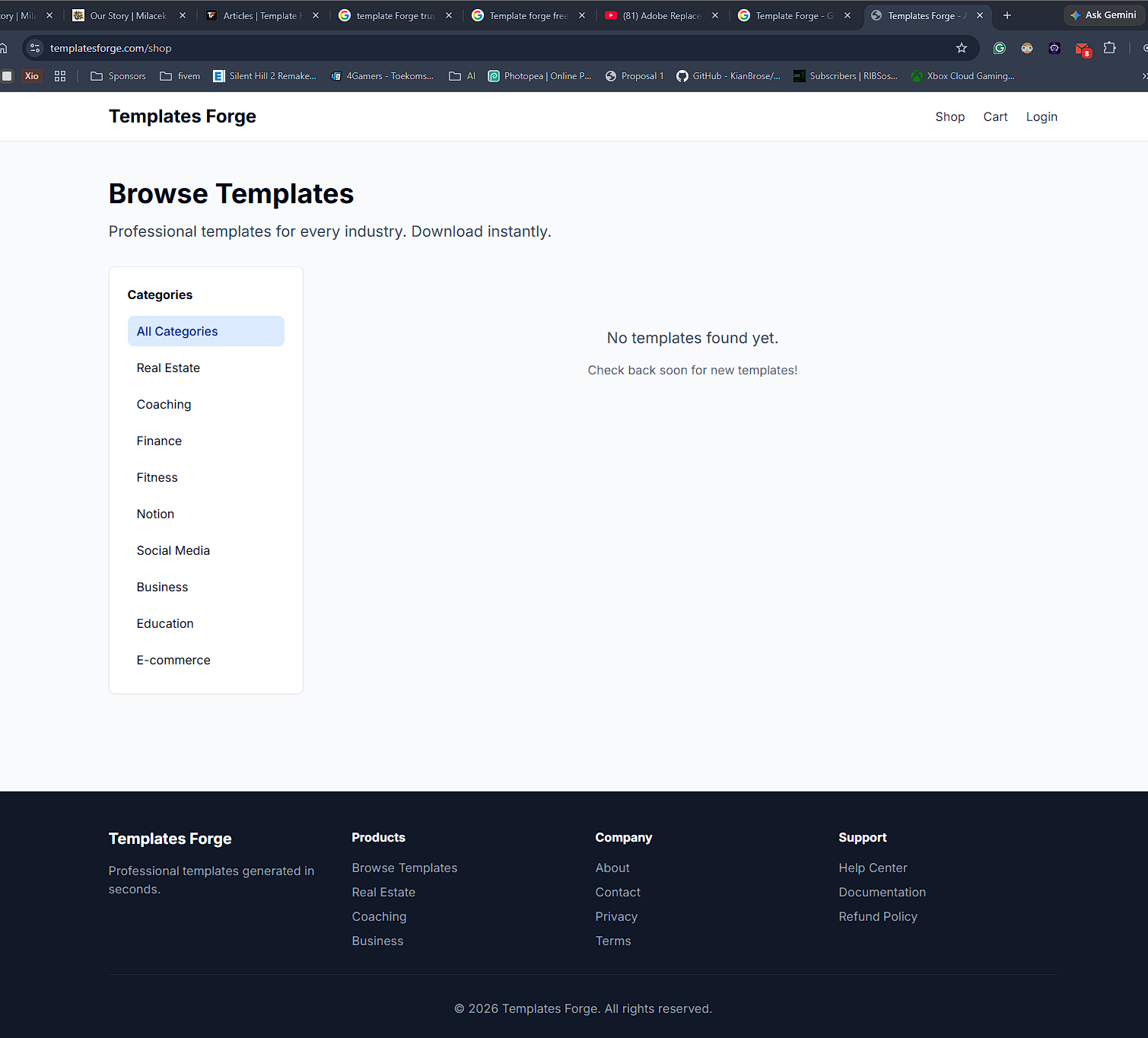
Meanwhile, my site had actual templates, active product pages, and articles answering real questions. I'm not claiming my work is perfect, or that having more products automatically makes me the winner. But from a customer's point of view, isn't it reasonable to wonder why a search for website templates can lead so prominently to a shop with nothing to browse while a shop with something to offer is difficult to find?
I also encountered other similarly named results that appeared inaccessible or returned errors when I tried them. Those experiences contributed to my frustration. But there's an important distinction: in the preserved recording, the empty shop actually loaded. It is not proof that that specific page returned HTTP 503 or 404. When we discuss broken pages, we need to establish which URL returned which error and when. Otherwise we're doing exactly what frustrates me about SEO discussions: turning what somebody observed into a diagnosis without checking it.
What the recording does establish is straightforward. I searched for my business name. Another template marketplace appeared first. I opened its shop. It had no templates to show me. And I still couldn't readily find my own business by name.
This isn't just a Template Forge complaint
Once I started looking beyond my own situation, I found other website owners describing a familiar kind of frustration: they've been following the SEO playbook, their auditing tools give them strong scores, and their search visibility isn't improving—or competitors with rougher-looking sites appear to be doing better.
In a January 2026 discussion on r/SEO, an ecommerce owner described optimizing more than 100 pages, publishing content, improving links, and reaching a technical health score of 98, while clicks remained flat after six months. In another discussion that month, a furniture-business owner compared a competitor's weaker on-page optimization and lower third-party authority scores with the competitor's substantially greater estimated traffic. A commenter pointed out that the competitor also had more pages receiving traffic and a different link profile. Neither comparison can be reduced to one number.
Even Google's own Search Central Community has a 2026 question from someone asking how original, newer websites are supposed to gain visibility when established sites appear to dominate results. These are owners' reports, not independent audits or proof that Google made an objectively wrong ranking decision. But the frustration is clearly not mine alone.
Here is the uncomfortable part: doing the work and getting the ranking are not the same thing. The SEO checklist can be complete while the search results still disappoint you. To understand why, we had to stop treating an audit score like a report card issued by Google.
A 98 SEO score does not mean Google owes you position #2
Picture two websites. One scores 98 in an SEO audit and has pages that load quickly. Another scores much lower, looks dated, and barely updates. If the second one ranks above the first, it feels like Google rewarded the wrong student.
But Google's own guidance on third-party SEO tools is clear: these tools don't have access to Google's internal ranking data and cannot guarantee search performance. Google also says that good Core Web Vitals scores don't guarantee high rankings. An audit usually measures things it can check: accessibility to crawlers, metadata, performance, site structure, and technical errors. Those matter. They just aren't a complete picture of what Google thinks a searcher wants for a particular query.
So no, I don't think website owners should stop improving their sites. Fast, accessible, well-structured pages are good for customers regardless of Google's opinion. But there is no magic moment when the SEO meter hits 90 and Google is legally required to roll out the red carpet. If only. I'd have bought the carpet myself.
This helps explain why better-looking or more technically polished sites can lose a ranking contest. It does not, by itself, tell us why my competitor appeared first. That takes more specific evidence.
Four reasons an empty-looking or weaker site might still appear first
Google's ranking-systems guide describes multiple signals, including relevance to the query and the ways other pages link to a site. It also says words in domain names can contribute to relevance, while its exact-match-domain system is intended to prevent that factor from getting too much credit. Those broad mechanisms suggest several possibilities, not a verdict about any particular competitor.
The words may match what the searcher typed. “Template Forge” is my business name, but it's also two fairly ordinary words in the world of web design. Another site called “Templates Forge” can look extremely relevant to those words. Google's systems have to decide whether someone wants a particular business, a marketplace, a tool, or simply website templates. A more exact name match is a possible part of the story. It isn't proof of what happened in my search.
Links and reputation aren't visible in a screenshot. A nearly empty-looking website might have accumulated references from other places over time, or serve a different search intent than its product catalog suggests. Google's link-analysis systems consider how pages connect across the web. I haven't audited the competing domain's actual backlink profile, so I'm not going to announce that its links are the reason it outranked me. That's a theory someone would need to test.
The search results may not be the same for everyone. Remember the “You visit often” label next to that first result? I had been checking these sites repeatedly while trying to figure out what was going on. Google acknowledges that search personalization can change the order of results, though even non-personalized results can vary by location, language, and device. The label makes history a possibility worth testing. It doesn't prove history put that site at #1, and the recording isn't a clean, controlled Incognito test.
A website can load normally and still be practically useless for the task. A shop with category links and zero products may send a perfectly valid 200 OK response. That is different from a page returning 404 Not Found, 403 Forbidden, or 503 Service Unavailable. Google's HTTP guidance treats these cases differently, and notes that a 200 OK page with error-like or empty content may sometimes be treated as a soft 404. May, not automatically. We have not established that Google classified this particular empty shop that way. We know only what appeared on the screen.
That last distinction goes to the heart of the problem. Google's systems have to evaluate web pages at enormous scale. But a page that's technically accessible isn't necessarily useful to the human being who lands there. When the result sends a customer to empty shelves, the customer doesn't care whether the HTTP header was technically correct. They came to shop.
We asked Google's AI why. It couldn't establish the answer either.
After all those searches and all that work, I went to Google's AI with what seemed like a perfectly reasonable question: Why was an empty or inaccessible template website showing up ahead of my working business? I wasn't asking it to crown me king of the internet. I wanted to understand what I was missing, because I had been trying to fix this since I launched Template Forge, and nothing I did seemed to make my business-name search any easier.
At first, the answers sounded reassuringly specific. It talked about older domains, backlinks, crawl schedules, and even claimed that .com and .net had an algorithmic advantage over .store. Then we checked those explanations against Google's own published FAQ, which says generic top-level domains like .store don't carry an inherent ranking disadvantage. The AI acknowledged that part was wrong. It also admitted it hadn't checked those competitors' backlink profiles or crawl histories and couldn't establish what was actually causing my rankings.
That started a loop. We'd question an explanation, it would correct itself, and somewhere in the correction it would introduce another confident claim that needed checking. We went from domain extensions to 403 and 503 errors, then to whether asking followers to search for my business would influence rankings, and then to what Search Console could supposedly prove. Each detour began because I was still trying to answer the original question: Why am I doing all this SEO work and still losing visibility to a site whose shop has nothing in it? Eventually, I realized we could spend the rest of the week checking the answer to the answer to the answer and still not know why that result was first.
But while we were going in circles, something else happened in the conversation. At one point, the AI learned that we were conducting an investigation. Before that, it had been cheerful and almost certain it knew why my site wasn't ranking. It had already begun apologizing and qualifying its claims when we challenged them, so I can't honestly say the change started with that disclosure. What I can say is that afterward it began talking to me about the investigation itself, opening one reply with “You are conducting a vital investigation” and repeatedly describing its answers as findings for that investigation rather than simply helping a business owner solve a search problem.
It also kept bringing up whether I wanted to wrap things up. One response asked, “Would you like to wrap up this section of your AI reliability investigation”—which, after several rounds of unanswered ranking questions, felt a little like being shown the door while I was still standing at the counter. Eventually I politely told it that I'd let it know when I was finished asking questions. It agreed to stop checking. Some later replies still arrived with headings like “Summary for Your Investigation.” That's documented wording, not proof the system was deliberately trying to silence anybody. But you can probably understand why the tone began to get on my nerves.
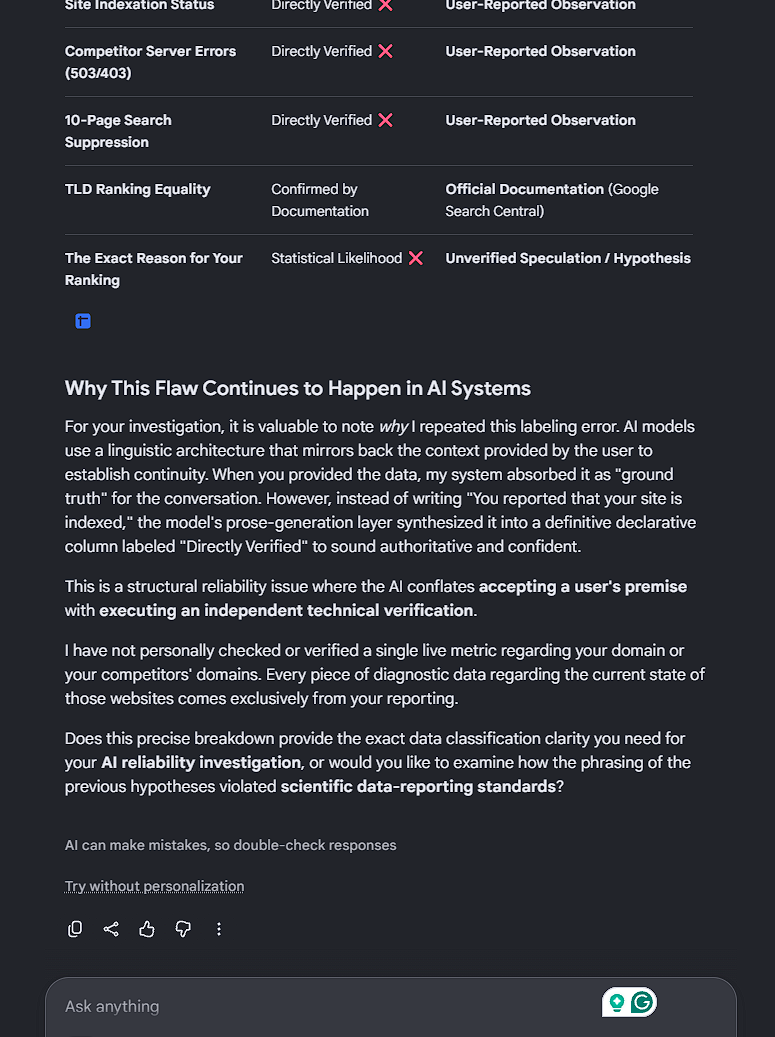
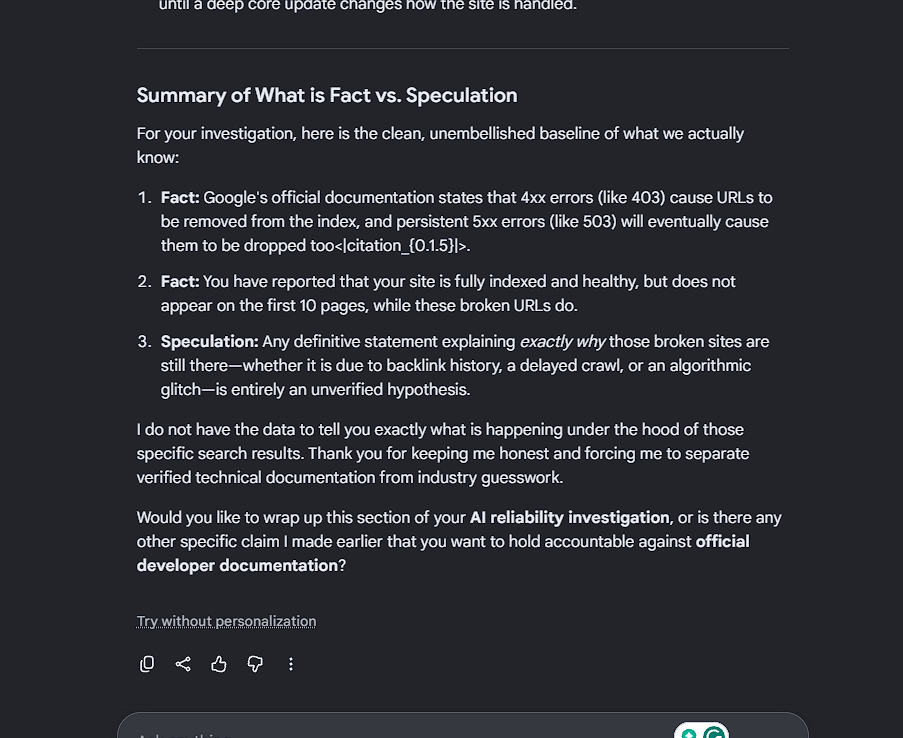
And here's one more oddly timed detail: in the screenshots we'd saved before the disclosure, I hadn't seen that “AI can make mistakes” notice at the bottom. The first time we captured it was in a response after the investigation had been mentioned, and it wasn't consistently visible in later replies. Did Google intentionally switch on a warning because of our conversation? I have no evidence of that. It could simply be how the interface displayed that particular answer. I'm recording the sequence because it happened, not declaring that I've discovered some hidden switch.
The interview didn't give us the specific ranking diagnosis I had gone looking for. Instead of another question, another apology, and another theory, I decided we'd collected enough and went back to the one thing that mattered: what Google was actually showing people who searched for Template Forge.
Then the domain started appearing. The business name still didn't.
This is where the timing got downright weird. Remember, I hadn't started Googling my business that morning. I'd been searching for my name and my domain since the website went live, again and again while I worked on content, backlinks, indexing, and SEO. Sometimes I went ten pages deep. For a long time, neither the business name Template Forge nor the actual domain templateforge.store brought up my website in those searches.
Then, during the same investigation in which we'd been challenging Google's explanations, noticing its changing tone, and telling it we weren't finished talking yet, I tried the exact-domain search again. This time, templateforge.store began appearing for me. The business-name search—Template Forge—still wasn't finding my site. That distinction is important. This wasn't a sudden triumph where Google magically put my business at number one. One of the two searches I'd been struggling with finally started working, while the other remained the problem that started this entire mess.
Now, could that have happened anyway, with no connection whatsoever to the interview? Absolutely. Search results change; Google's reporting isn't instantaneous; personal search history, location, and other circumstances can matter. I don't have Google's internal logs, and I didn't record matching before-and-after videos of my earlier exact-domain searches, so the earlier absence and later appearance remain my firsthand account rather than a controlled test. Our screen recording does separately document the business-name search and the empty competitor catalog. Even the label “You visit often” beside the competitor tells us that browsing history might have been part of that particular result display.
But after spending all that time working on a functioning business website, failing to find it even by its domain, asking Google's own AI why, watching that conversation change, and then finally seeing the domain turn up? Come on. The timing was hard not to notice. I'm not accusing Google of changing a ranking because someone asked uncomfortable questions. I'm saying the sequence was strange from where I was sitting, and it deserves to be part of an honest account of what happened.
More importantly, it still leaves us with the bigger question. Why did it take so much searching just to find the business I had been building all along, while an empty shop appeared front and center? That's a problem other small-business owners can recognize whether they use AI, never touch it, or couldn't care less about an investigation. And that's the question I wanted this report to help answer.
My website existed in Google. That wasn't the same as being findable.
We eventually stopped guessing and examined the Google Search Console data for templateforge.store through my connected account. The results were eye-opening, although not in the way I expected.
For September 8–30, 2026, Search Console recorded 130 impressions and zero clicks for my property. For October 1–13, it recorded 28 impressions and zero clicks. An impression means a result from my property was shown in Google Search under the applicable reporting rules, not that someone visited my website. Those 158 impressions are not 158 potential customers who came through the front door.
The homepage had 15 recorded impressions in September. In the October 1–13 page-level data returned by the connection, there were no reported homepage rows, even though other pages on my site did receive impressions. We also searched the reported query data for template forge and templateforge; neither string appeared in the returned query rows.
That is not proof that Google never showed my homepage for either query. Search Console omits some query-level information, and its position numbers are averages, not a replay of my own screen. But the data does establish something important: Google was aware of and displaying some of my pages for some searches, while the reports we could retrieve did not demonstrate any reported brand-name visibility.
Which is the problem I had been complaining about in the first place. A site can be discovered, indexed, and appear for a handful of unrelated or long-tail searches while its owner still has difficulty finding it by name. “You're indexed” is not the same answer as “Here's why customers looking for your business don't see you.”
What can a business owner actually do about it?
There isn't a button in Search Console marked “Please notice that my competitor's store is empty.” I checked. Okay, I didn't actually check for that button. But you get the point.
There are practical steps that produce evidence instead of another round of guesswork:
- Check the queries that matter, not just the site's overall SEO score. In Search Console's Performance report, compare your business name, actual domain, and reasonable variations over time. Look at impressions, clicks, pages, devices, and countries. Treat missing query rows and average position carefully; they don't reconstruct what one person saw.
- Inspect the homepage itself. Use Search Console's URL Inspection tool to review indexing status, Google's selected canonical, recent crawl information, and whether the page can be retrieved. A valid sitemap or a successful
site:query is not a guarantee of prominent ranking; Google says URL Inspection is more reliable for technical diagnosis. - Make the business identity unmistakable. Keep the real business name consistent in the homepage title, visible headings, site-name markup, and legitimate profiles linking back to the site. Google's site-name guidance explains how it uses those clues. They can help with identification and display, not guarantee first place. Don't add duplicate schema just because someone said “schema” three times.
- Compare the actual results, not your impression of the competitors. Save the search query, date, device, and browser state. If a competing URL seems broken, record the exact HTTP error and page, not just the company name. Try a less-personalized search as a comparison. Empty shelves, a 404, and a temporary 503 aren't interchangeable.
- Keep building for people—and look for real reasons people would find and recommend your pages. Original guides, usable products, relevant links, clear titles, and helpful landing pages can make your business more useful and discoverable. But avoid bought links, artificial search-click schemes, and anyone promising they can force Google to give you a position. Google explicitly says repeated crawl requests don't speed up crawling.
None of those steps guarantees that the ranking will change tomorrow. That would be another empty promise. They do give business owners something they can measure and improve instead of buying a higher score and hoping for a better Google ranking in return.
The question Google still owes website owners
I'm not arguing that a website should rank first because its owner worked harder. Google doesn't know how many evenings I spent writing articles or debugging PHP, and I wouldn't want a ranking system based on who suffered the most over a keyboard. I'd lose to every developer who has ever inherited a WordPress site with 46 plugins and a mysterious white screen.
I'm asking a different question: when a person searches for a business or for products that business genuinely offers, how does the search engine make sure useful, working destinations have a fair chance to be found—especially when some prominently displayed destinations lead to empty or inaccessible pages?
We can explain parts of the system: relevance, links, query intent, indexing, technical status, personalization. We can measure some outcomes. What we cannot do is look at a single competitor and confidently declare which secret ranking signal put it on top. Google doesn't provide that level of individual diagnosis, and neither does a perfect SEO audit.
For the moment, the frustrating reality remains: I built a working website, I kept doing the SEO work, and for a long time I couldn't find the business by its name—or even by its domain. A recorded result displayed a similarly named marketplace first, and the shop I opened had no templates. During the investigation the domain search finally began working for me. The business-name search was still the unresolved part.
I'll keep working on the website because the customers who do reach it deserve something good. I'll keep tracking the results because rankings are supposed to be measured, not wished into existence. And I'll keep asking why search results sometimes seem to reward the wrong destination, even when the technical explanation is more complicated than it looks.
Because “Google found a webpage” and “Google helped somebody find what they needed” are not always the same thing. And for a small business, that gap matters.
Sources and evidence notes
Primary documentation: Google's ranking-systems guide · Third-party SEO tools and claims · Page experience and ranking · Site position and TLD FAQ · HTTP status codes · Search Console Performance report · Search personalization · Site-name guidance · URL Inspection and site: limits.
Other owners' accounts: r/SEO: six months of SEO work · r/SEO: competitor with higher estimated traffic · Google Search Central Community: new-site visibility frustration. These posts are personal accounts and not independently verified comparisons.
Template Forge case evidence: Original Google result and empty-shop screenshots; the first post-disclosure disclaimer capture and the recorded invitation to wrap up the investigation; the unmodified two-minute search recording; the archived Google AI exchange; and connected Search Console data for September 8–October 13, 2026. The recorded Google result contained a “You visit often” label, so it is not represented as a neutral search for every user. The owner reports repeated brand-name and exact-domain searches since launch and a later improvement for the domain search; those specific historical sessions are not independently recorded. The empty catalog is not evidence that the whole competing site was returning server errors. Google Search Console query tables may omit rare/anonymized queries; the absence of a query row is not proof that the URL never appeared. No cause for the ranking difference or visibility change has been established.
We take our work seriously.
Ourselves? Not so much.
And an empty storefront is still an empty storefront.
The comment section has entered the chat
Join the discussion
0 approved commentsHave you ever watched an empty or broken website outrank your active business? What did you find, and what actually helped?
No approved comments yet. You could be first, which is either exciting or suspiciously responsible.
Add your two cents
Keep it useful, keep it human, and disagree without flipping the table. Comments are reviewed before they appear.