
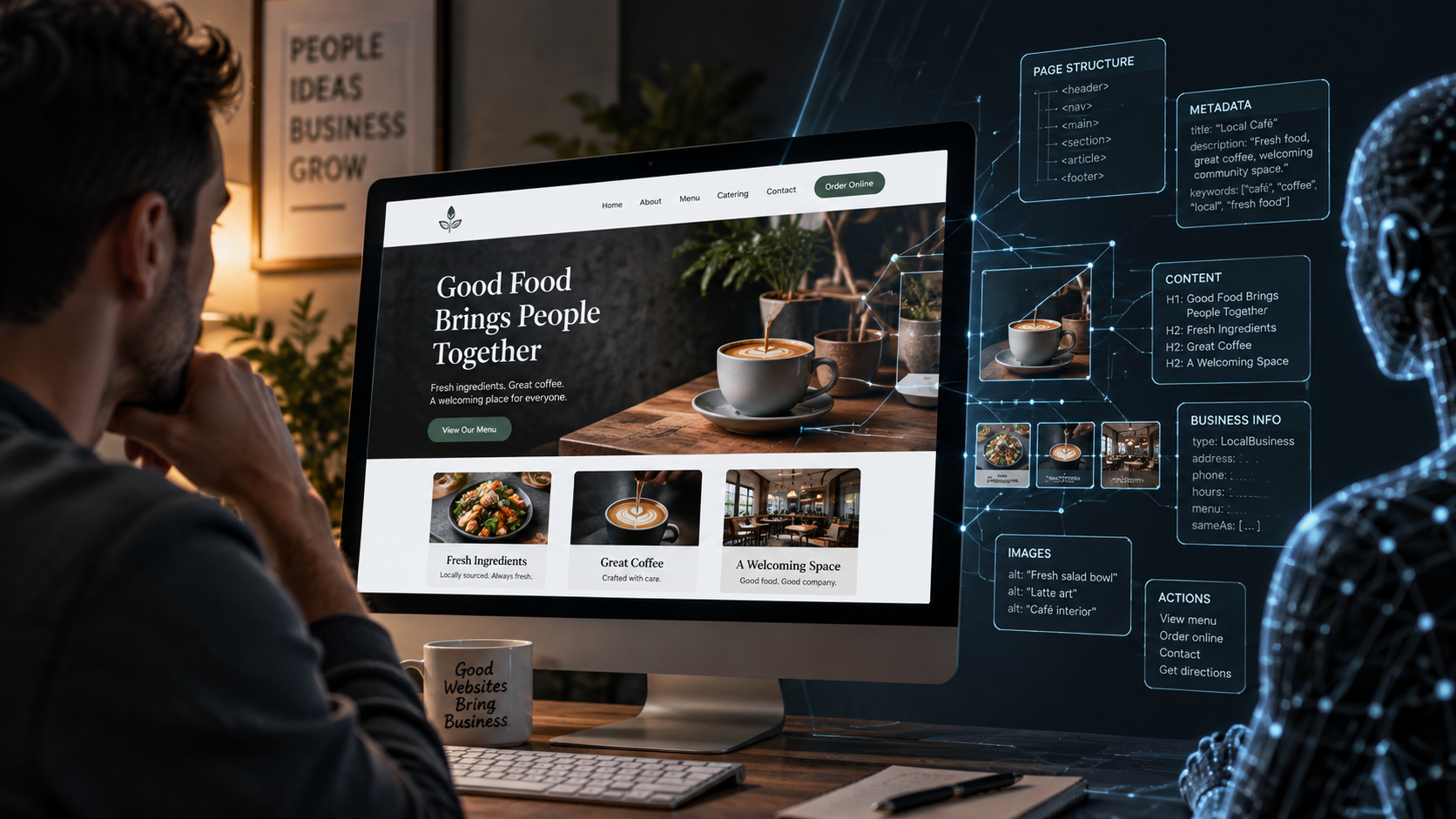
I think we’re about to have one of those web design conversations that sounds ridiculous the first time you hear it, then six months later everybody acts like we’ve always been talking about it.
Who exactly are we designing websites for now? The customer or the customer’s AI?
Before somebody throws a keyboard at me, yes, obviously human beings still matter. 😂
People still need to visit a website, understand what they’re looking at, trust the business, find what they need, and hopefully buy something, book something, call somebody, or do whatever the website was built to make happen.
But there’s another visitor starting to show up, and it doesn’t care how pretty your hero section is.
The bots aren’t just crawling anymore
For years, websites had two basic audiences. Humans read them and search engines crawled them. That arrangement was pretty easy to understand. Make the website useful for people, structure it properly for Google, sprinkle in some SEO, sacrifice a goat to the algorithm every couple of months, and carry on with your life.
Now AI agents are getting involved.
Google is building more shopping experiences where AI helps people research products, compare options, ask questions, and move toward a purchase. Google recently expanded tools specifically designed to help retailers understand how they appear across its AI experiences.
Cloudflare is talking openly about an “agentic web” and has even created tools for checking whether a website is ready for AI agents. Their point is pretty simple: the web learned how to communicate with browsers, then search engines, and now it has another thing knocking on the door.
So apparently websites have a new roommate... Wonderful. 😂
This changes what “good website” means
Imagine somebody tells an AI assistant:
Find me a local bakery that makes custom birthday cakes, can handle a peanut allergy, delivers on Saturday, and stays under $150.
The AI doesn’t need to fall in love with the font pairing. It needs information.
Does the bakery make custom cakes? Does it handle allergies? Where does it deliver? What days is it open? What does it cost? How do you order?
Now imagine the bakery has an absolutely gorgeous website, except the allergy information is buried inside an image, the delivery area is vaguely described three pages deep, the pricing says “contact us,” and the hours on the website haven’t been updated since the Obama administration.
That's a beautiful site. Now wish the robot good luck and, honestly, good luck, humans too.
That’s the funny part about all of this. A lot of what supposedly makes a website “AI ready” is stuff we should have been doing for people already.
Clear information, logical structure, useful page titles, good product descriptions, real service details, accurate policies, accessible content, fast pages, navigation that doesn’t require a treasure map.
Maybe the robots aren’t asking us to reinvent web design. Maybe they’re just exposing all the crap we’ve been getting away with.
Please don’t turn your website into a spreadsheet
There is another direction I can already see this going, though. Somebody is going to decide that if AI agents are important, design no longer matters, and then we’re going to get websites with all the personality of a tax form because somebody read a blog post saying machines like structured information.
No. The answer is not to make websites uglier for robots.
Humans still have emotions, preferences, trust signals, brand recognition, taste, and an attention span that occasionally survives longer than eight seconds.
Design, branding, photography, typography, and personality definitely still matter.
A restaurant should still feel like a restaurant.
A tattoo shop should probably not look like a regional bank.
A landscaping company does not need the same homepage as a SaaS startup just because somebody discovered rounded cards.
The challenge is making all of that personality sit on top of information that is actually understandable by both audiences.
SEO might be turning into something bigger
This is where things get interesting for small businesses. For years, the goal was pretty straightforward: Get found on Google, get the click, and get somebody onto your website.
But AI-driven discovery can change that path.
Someone might ask an assistant for recommendations, compare businesses inside the conversation, narrow the choices down, and only visit one or two websites at the very end. Sometimes the website may be providing information long before the person ever sees it. That means businesses may eventually care about more than where they rank. They’ll care whether AI systems understand what they sell, whether their information is accurate, whether they get mentioned, whether they get cited, and whether they make the shortlist in the first place.
People are already building dashboards specifically to measure this kind of AI visibility across systems such as ChatGPT, Gemini, Perplexity, and Google’s AI search experiences, although the measurement is still far from perfect. That feels like a pretty big shift. We spent years fighting over position number one. Now we might also be fighting over whether the answer mentions us at all.
And no, the robots are not taking over tomorrow
This stuff is still messy.
A recent test looked at 45 AI agents performing real browsing tasks, and not one of them achieved a perfect score. Things like forms, transactions, multiple tabs, and third-party integrations can still trip them up. So I would not recommend anybody panic tonight and install 47 AI plugins on their website.
Please don’t.
Your hosting account has suffered enough. But I would start paying attention because web design has always changed depending on how people use the web.
We adjusted for mobile.
We adjusted for search engines.
We adjusted for accessibility.
We adjusted for touchscreens, different screen sizes, faster expectations, ecommerce, social media previews, voice search, and whatever fresh nonsense Google decided to measure that year. AI agents might simply be the next adjustment and the websites that handle it best probably won’t be the ones built entirely for machines. They’ll be the ones that are clear enough for machines to understand without becoming boring for the humans who eventually arrive... Which leaves us with a weird question I didn’t expect web designers to be asking this soon:
So who are we designing for now?
Are we still designing websites for visitors?
Or are we starting to design them for visitors and whatever they send ahead to do the shopping first?
Sources / further reading
The comment section has entered the chat
Join the discussion
0 approved commentsAre websites starting to serve two audiences now: people and AI agents? Where do you think this goes next?
No approved comments yet. You could be first, which is either exciting or suspiciously responsible.
Add your two cents
Keep it useful, keep it human, and disagree without flipping the table. Comments are reviewed before they appear.