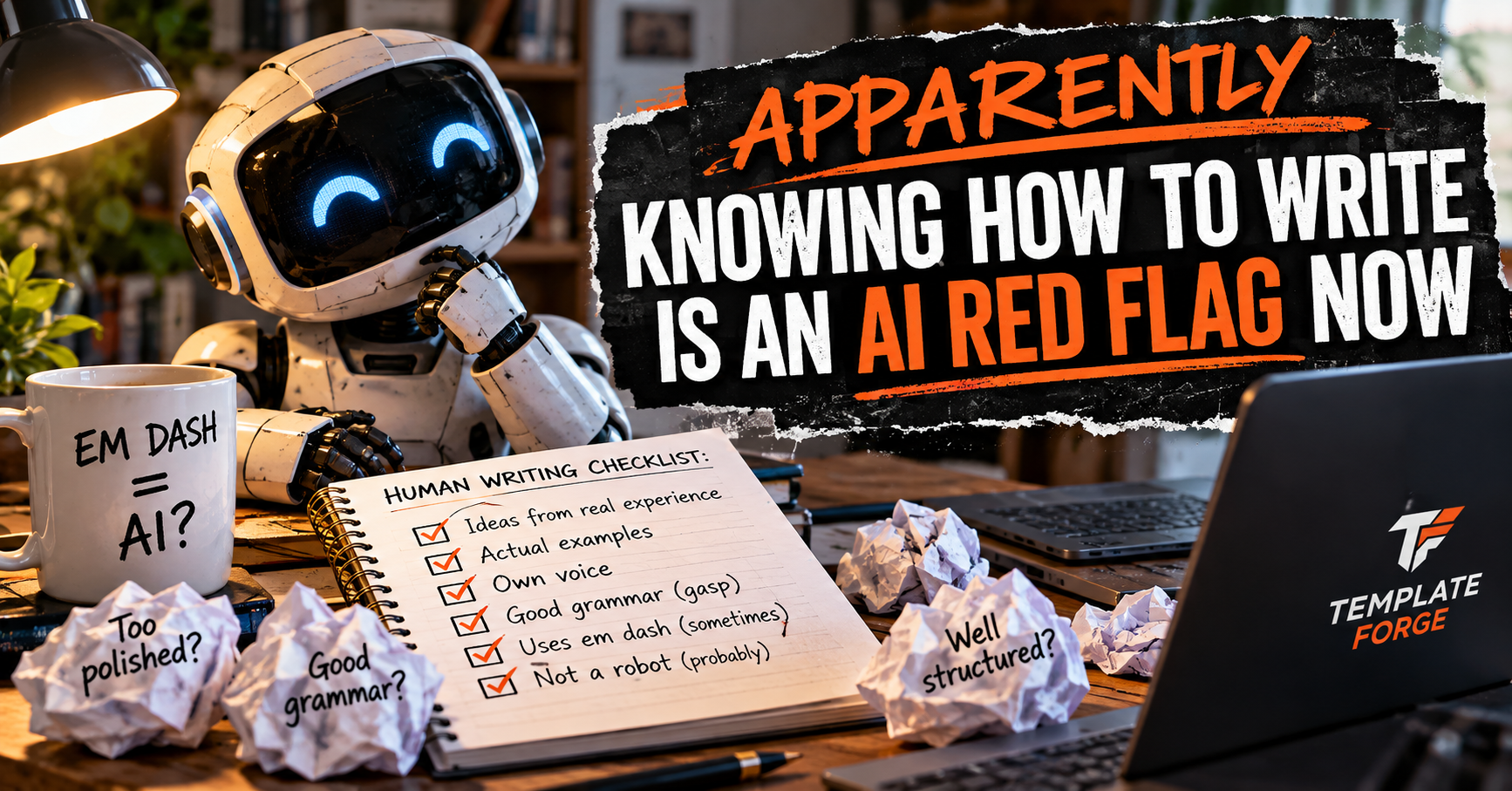
At some point, punctuation became evidence.
You have probably seen the posts by now. Somebody spots an em dash in an article, a LinkedIn post, an email, or a comment and immediately announces that AI wrote it.
Sometimes the accusation expands. The grammar is too clean. The paragraphs are too organized. The vocabulary is a little too good. The writer used three examples in a row. There is an Oxford comma. Everything is suspicious now.
The funny part is that none of these observations are completely invented. AI models really do develop recognizable writing habits. The problem starts when a recognizable habit gets promoted into proof.
That is how we ended up in the weird position of treating competent writing like somebody left fingerprints at the scene.
The em dash did not suddenly become artificial.
Writers were using em dashes before ChatGPT, before large language models, before social media, and before anybody thought a punctuation mark needed to defend its humanity.
Journalists use them. Novelists use them. Academics use them. Copywriters use them. People who enjoy punctuation a little more than the rest of us use them.
Then AI models learned from enormous collections of human writing, picked up the same punctuation, and started using some of those patterns more frequently than people usually do.
Now humans use the punctuation and get accused of copying the machine that learned it from humans.
Beautiful. We have invented plagiarism in a circle.
Pew Research Center analyzed about 490,000 English language webpages from the Common Crawl archive and found that em dashes appeared about twice as frequently on newer webpages as they did in its 2023 comparison. Oxford commas increased too, along with several words and sentence patterns that AI systems tend to favor.
Pew also makes the part people keep skipping very clear: those features by themselves do not prove that AI wrote a particular piece.
Patterns are real. The courtroom drama is optional.
There is nothing wrong with noticing patterns.
If you read enough AI generated writing, you start recognizing things. Certain transitions show up over and over. Sentences arrive in neat little groups. Everything is balanced. Every paragraph knows exactly where the next paragraph is going. Certain words suddenly become very popular.
That can be useful information.
But a pattern is not the same thing as provenance.
If somebody uses one phrase AI also likes, that does not tell you who wrote the paragraph. If somebody uses an Oxford comma, that does not tell you who wrote the paragraph. If somebody writes three examples instead of two, congratulations, you have discovered the number three.
A writing tell can raise a question. It cannot answer the question by itself.
The more independent clues you have, the more reasonable the suspicion can become. That is how patterns work. One signal gives you almost nothing. A consistent cluster of signals gives you something worth examining.
The internet prefers the shorter version because "I saw punctuation" fits nicely into a comment box.
Then "sounds like AI" started meaning "sounds edited."
This is where the conversation gets more interesting than the em dash.
People are not only suspicious of punctuation anymore. They are suspicious of polish.
A sentence is clean. Suspicious. A paragraph flows well. Suspicious. The writer does not make obvious spelling mistakes. Suspicious. The argument has a beginning, middle, and end. Somebody call the authorities.
That sounds like a joke until you look at what AI detectors struggle with.
A 2026 study examined more than 135,000 pairs of human written academic manuscripts before and after professional English editing. The authorship and subject stayed the same. The writing got edited.
Across 13 AI detectors, the edits did not produce one reliable direction. Some detectors became more suspicious after editing. Others became less suspicious. The amount of editing also affected the scores.
The author did not change. The topic did not change. The polish did.
That should make anybody a little cautious about treating "this sounds too clean" as a serious authorship test.
It also connects to a bigger question we have been circling around on Template Forge: AI is changing the web even when it is not directly creating the thing in front of you. The same shift shows up in Your Next Website Visitor Might Not Be Human, where the interesting part is not simply what AI can generate, but how its presence changes everybody else's behavior.
AI detectors can put a percentage on uncertainty. That does not make it certainty.
Automated detectors have the same basic problem, except they get to put a number beside it.
A recent review in AI and Ethics looked at the limitations of AI writing detectors and included a particularly ugly example. The same known human authored manuscript was submitted to five commercial detectors.
The tools did not politely disagree around the edges. They produced dramatically different answers.
That does not mean every AI detector is useless. It means the output needs context, especially when the consequence is accusing an actual person of lying about their work.
Another large evaluation published through the Association for Computational Linguistics looked at 15,000 samples of human writing that had been polished with different amounts of AI assistance. The researchers found that detectors frequently flagged even lightly polished text as AI generated and struggled to tell the difference between different levels of AI involvement.
Which raises another problem nobody solves by yelling "em dash."
What exactly counts as AI written anymore?
If a human writes every idea and every sentence, then runs the text through a grammar tool, is that AI written? What if AI rewrites one paragraph? What if it fixes spelling? What if it suggests a title? What if it changes three sentences and the writer rejects two?
Authorship has become a spectrum in some workflows, while a lot of detection tools are still being interpreted like a light switch.
The worst incentive is writing worse on purpose.
Once writers believe clean writing will get them accused of using AI, the obvious reaction is not difficult to predict.
Remove the suspicious punctuation. Break up the structure. Avoid certain words. Leave a sentence a little rough. Maybe keep a typo because at least nobody will accuse the typo of using ChatGPT.
We have somehow created a world where bad editing can start feeling like an alibi.
That is backwards.
Human writing is allowed to be polished. Human writing is allowed to be formal. Human writing is allowed to have rhythm. Human writing is allowed to contain punctuation that existed before a chatbot account had a login button.
It is also allowed to be messy, inconsistent, weird, blunt, repetitive, funny, boring, brilliant, or terrible. Humans have been producing the entire range for quite a while.
If you are writing content for your own business, this matters for another reason. The goal was never to make every paragraph pass somebody's imaginary humanity test. The goal is to say something useful in a voice that belongs to the business.
That is one of the reasons the question in Does Your Small Business Actually Need a Blog, or Are We All Just Pretending? matters more now. Publishing words because a content calendar demanded them was already a bad strategy. Publishing intentionally worse words so they look more human would be an impressive way to make it worse.
So how do you judge writing without becoming punctuation police?
Start by separating two different questions.
The first is whether the writing has characteristics commonly associated with AI. That is a style question.
The second is who actually produced the work and how. That is a provenance question.
Those are not the same question.
Does the piece contain concrete experience, original observations, details, examples, or decisions that actually belong to the writer?
Does the voice resemble the person's other work, or did it suddenly become a completely different writer overnight?
Are factual claims supported, and do the sources actually say what the writer claims they say?
When authorship genuinely matters, drafts, notes, revision history, research, and the writer's ability to explain the work tell you far more than one suspicious punctuation mark.
None of those tests is magic either. That is the point.
There is no single punctuation mark, phrase, detector score, sentence length, or vocabulary word that can carry the entire burden of proving authorship.
And yes, Template Forge avoids em dashes.
Which is a very convenient confession to make in this particular article.
Template Forge has a house style rule against em dashes. We do not use them.
That is a style choice.
It is not because the punctuation is guilty.
Plenty of human writers have used em dashes forever and should keep using them if that is how they naturally write. Plenty of AI systems can also be told not to use them. Removing one character does not suddenly make machine generated writing human, and using one does not turn human writing into machine output.
A house style is useful because it creates consistency. A house style pretending to be forensic science is something else.
Maybe the real red flag is certainty.
AI has changed the texture of online writing. That is real. It has also made readers suspicious of writing habits that were human long before modern AI existed.
We should absolutely get better at recognizing synthetic content. We should also get better at admitting when a clue is only a clue.
If your entire AI detector is one punctuation mark, you are not detecting AI. You are doing punctuation astrology.
Sources and further reading
- Pew Research Center: How Much of the Internet Is Written With AI?
- AI and Ethics: The pitfalls of AI detection in academic writing
- Style as a Confound: False Positives in AI Detection of Non-Native Academic Writing
- ACL Anthology: Almost AI, Almost Human: The Challenge of Detecting AI-Polished Writing
The comment section has entered the chat
Join the discussion
0 approved commentsHave you ever had something you wrote called AI because of punctuation, grammar, vocabulary, or because it looked too polished?
No approved comments yet. You could be first, which is either exciting or suspiciously responsible.
Add your two cents
Keep it useful, keep it human, and disagree without flipping the table. Comments are reviewed before they appear.