I thought I already knew the answer before I started looking.
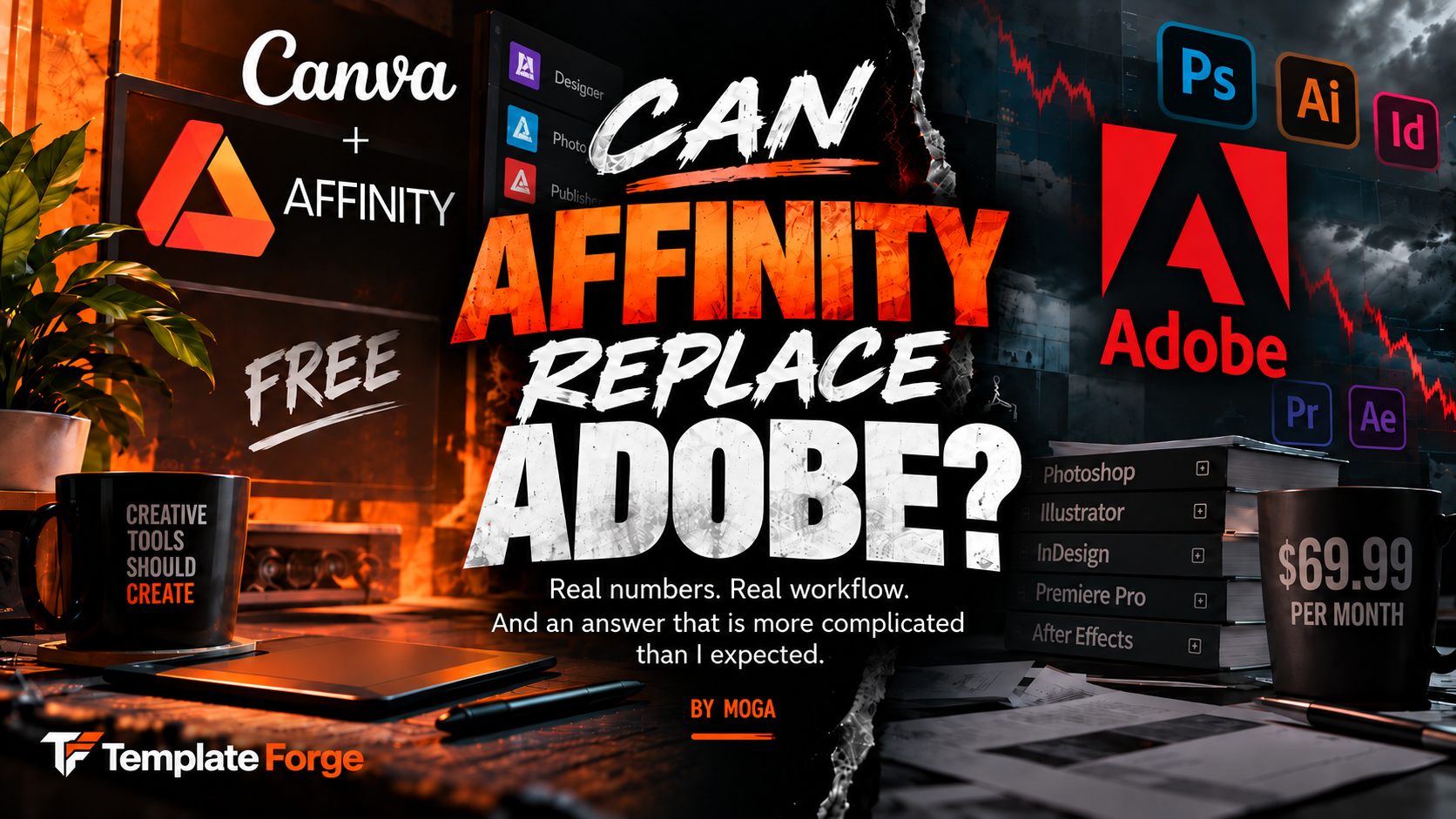
Can Affinity replace Adobe?
My first reaction was basically, "Come on. Adobe is Adobe."
Photoshop, Illustrator, InDesign, Acrobat, Premiere, After Effects, Creative Cloud Libraries, fonts, plugins, decades of files, agencies built around the workflow, printers expecting the formats, clients sending you files and assuming you can open them. Adobe is not one program. It is an entire ecosystem that a ridiculous amount of the creative industry has been standing on for years.
Affinity has always been the thing people bring up when somebody says they are tired of paying Adobe every month.
Good software? Sure.
Cheaper alternative? Absolutely.
Replace Adobe?
That always felt like a bigger claim.
Then I started looking at what Canva has actually been doing with Affinity, what Adobe investors have been doing with Adobe, and what designers who are actually switching are saying.
Somewhere in there, this stopped feeling like the same question it was a few years ago.
The old answer was easier.
For a long time, the Adobe argument had a built-in ending.
You could complain about the subscription. You could hate Creative Cloud. You could swear every year that this was finally the year you were leaving. Then somebody sent you a PSD, an Illustrator file, or an InDesign package and everybody went back to work.
That kind of lock-in is powerful because it is not only about features. It is about familiarity.
If you have spent ten or fifteen years in Illustrator, you are not thinking about where the Pen Tool is anymore. Your hand knows. You know the weird workaround for the weird thing. You know which menu hides the option you need. You know exactly how much nonsense the program will tolerate before it decides today is the day it hates you.
That has value.
I saw this exact thing in recent Affinity discussions. Designers who are trying to switch keep coming back to the same problem: the software may be capable, but years of Adobe muscle memory make them slower at first.
That is a much harder problem to solve than adding another button.
Then Affinity became free.
And I do not mean "free trial," "free with limits," or "free until you click the button you actually need."
Affinity's core vector, photo editing, page layout, customization, and export tools are free.
That changes the argument immediately.
Canva says more than one million people signed up for Affinity in the first four days after it became free. By April 2026, Canva said more than five million creatives had adopted it.
I am not saying free automatically means better. Plenty of terrible things are free. Spam is free. Mosquitoes are free.
But price matters when the thing on the other side is no longer a toy.
Affinity can handle vector work, photo editing, RAW development, page layout, CMYK output, spot colors, preflight, data merge, PSD files, Illustrator files, IDML imports, and professional exports. The September 2026 update added more than 60 improvements, including the long-requested Blend Tool, scripting, deeper RAW editing, new automation, and tighter integrations with other professional tools.
At that point, zero dollars becomes a very different number.
If you want the software side of this without me staring suspiciously at Adobe's subscription price, Echo breaks down Affinity 3.3 itself in Affinity 3.3: What's New, What's Better, and What Adobe Users Should Know, including what actually improved, what Adobe users will notice, and where Affinity still has work to do.
Canva is not building a cheap Adobe alternative anymore.
This might be the part I underestimated the most.
Adobe's biggest advantage has never been Photoshop by itself. It is that Adobe has a tool for damn near everything.
Need vector work? Illustrator. Photo editing? Photoshop and Lightroom. Layout? InDesign. Video? Premiere. Motion? After Effects. PDFs? Acrobat.
That ecosystem is the moat.
Canva apparently noticed.
Its new ProSuite connects Affinity, Cavalry, Leonardo, and Flourish. Affinity handles design, photo editing, and layout. Cavalry handles motion. Leonardo handles generative media. Flourish handles data visualization. Canva sits around all of it handling collaboration, brands, and distribution.
Affinity now syncs with Canva Brand System. Capture One supports Affinity's native file format. DaVinci Resolve supports it too, including automatic refreshes when the Affinity file changes.
That is not somebody building one good Illustrator competitor.
That looks like somebody trying to build another creative ecosystem.
Adobe's real danger is not one Affinity app. It is the possibility that designers can build a serious professional workflow without needing Adobe in the middle of it.
But Adobe is not dying. Not even close.
This is where I have to ruin the fun for anybody who came here hoping for "ADOBE IS FINISHED" in giant red letters.
The financial numbers do not support that.
Adobe just reported record third-quarter fiscal 2026 revenue of $6.76 billion, up 13 percent year over year. Its annualized recurring revenue reached $27.5 billion. Subscription revenue from Creative and Marketing Professionals reached $4.65 billion, also up 13 percent.
Adobe did so well that it raised its full-year revenue and earnings targets.
A company generating record revenue and more than $27 billion in annualized recurring revenue is not sitting in the parking lot wondering how it is going to make payroll.
Affinity is becoming a real competitor. That is very different from saying Adobe has already lost.
Adobe also has something Affinity cannot manufacture overnight: decades of installed workflow.
Companies have archives full of Adobe files. Agencies have processes built around Creative Cloud. Printers expect certain files. Designers know the shortcuts. Clients own templates. Teams share libraries. Plugins depend on the platform.
Replacing software is easy compared with replacing infrastructure.
Then I looked at Adobe's stock.
This is where things get weird.
Adobe is making more money, but investors have been punishing the stock anyway.
As of September 25, Adobe closed around $235 per share. Market data showed the stock down roughly 33 percent over the previous twelve months, while the company's market value had fallen to around $92 billion.
At the end of 2023, Adobe's market value was roughly $272 billion.
So we have a company whose revenue keeps growing while the market has cut a huge chunk out of what investors think that company is worth.
That does not prove Affinity is taking over.
I want to make that very clear because otherwise this turns into one of those stock charts where somebody draws an arrow and suddenly thinks they discovered economics.
Canva is private. There is no Canva stock chart sitting next to Adobe's proving that investors picked a winner. Adobe's stock problems also involve AI competition, leadership changes, growth expectations, Figma, Canva, and a software market that looks very different from the one Adobe dominated ten years ago.
Reuters has reported exactly that kind of investor anxiety. Even when Adobe has beaten expectations, the market has remained nervous about competition and whether the company is moving quickly enough as creative software changes.
That is the interesting signal.
The market is not saying Affinity already won.
The market appears much less convinced that Adobe's dominance is untouchable.
There is still a wall Affinity has to get through.
File compatibility is much better than I expected.
Affinity can import PSD, AI, IDML, DWG, and other professional formats. PSD layers can come across with editability preserved in many cases. InDesign IDML files can preserve page structure, text frames, and basic styles.
But "can open it" and "can replace the workflow" are not the same thing.
Affinity itself notes that advanced InDesign formatting such as GREP styles, anchored objects, and tables may require manual adjustment. More importantly, Affinity cannot export back to INDD or IDML.
That is not a small detail if you work in an agency where the client expects an editable InDesign package at the end.
Photoshop compatibility has caveats too. Advanced objects and filters may not always translate perfectly depending on the file and workflow.
If you control your files, deliver finished assets, and mainly need photo, vector, branding, and layout work, Affinity is becoming very hard to dismiss.
The answer depends heavily on clients, handoff formats, plugins, and whether everyone is willing to learn a new workflow.
Adobe's ecosystem, legacy files, collaboration habits, and industry compatibility are still serious advantages that a free download does not magically erase.
This is where Adobe should probably pay attention. Somebody starting today no longer has the same reason to build their entire career around Adobe by default.
That last one might matter more than anything else.
If I already have fifteen years of Adobe muscle memory, leaving has a cost.
If I am seventeen, learning design today, and one professional toolset costs nothing while the other one wants a monthly payment, that decision looks completely different.
So can Affinity replace Adobe?
I hate answers that start with "it depends," but unfortunately this one actually does.
Can Affinity replace Photoshop, Illustrator, and InDesign for a lot of independent designers, photographers, illustrators, and small studios?
I think the answer is increasingly yes.
Can Affinity replace the entire Creative Cloud ecosystem for every agency, production department, video team, print workflow, client handoff, plugin dependency, and twenty years of archived files?
No. Not cleanly.
But after digging into this, I also think that might be the wrong question.
Affinity does not need to replace Adobe at everything.
Canva does not need every designer on Earth to uninstall Creative Cloud tomorrow.
They only need enough people to look at a $69.99 monthly subscription, look at a free professional tool that keeps getting better, and ask themselves one uncomfortable question:
What am I actually paying Adobe for?
That is where I think Adobe should be paying attention.
Adobe still has the money, the users, the ecosystem, the file formats, the industry habits, and a massive head start. Affinity has not taken that away.
What Affinity has done is make the alternative feel real.
And once people start believing they have a real alternative, dominance gets a lot more expensive to maintain.
Affinity does not have to become better than Creative Cloud at everything. It only has to make enough designers realize they do not need Creative Cloud for everything.
Sources and further reading
- Canva: Why we made Affinity free, and how we will keep it that way
- Canva: Canva Create 2026 launches
- Canva: Introducing the Canva ProSuite
- Affinity: Blend Tool, Scripting, and over 60 updates
- Affinity: Page layout and InDesign compatibility
- Adobe: Creative Cloud pricing
- Adobe: Q3 fiscal 2026 earnings release
- Stock Analysis: Adobe market capitalization history
- Reuters: Adobe investor concerns around competition and AI
- Reddit: Designers discussing the move from Adobe to Affinity
The comment section has entered the chat
Join the discussion
0 approved commentsIf you use Adobe professionally, what would Affinity still need before you could realistically replace Creative Cloud in your workflow?
No approved comments yet. You could be first, which is either exciting or suspiciously responsible.
Add your two cents
Keep it useful, keep it human, and disagree without flipping the table. Comments are reviewed before they appear.